

Key Takeaways
- Food grade starch is essential for safe food manufacturing, while industrial grade starch serves various non-food applications.
- Understanding starch types can prevent costly substitutions and ensure product quality in your manufacturing processes.
- Buyers should evaluate moisture content, viscosity, and purity when selecting starch from Starch Manufacturers in India.
- Food grade starch requires strict compliance with safety and quality standards to ensure human consumption suitability.
- Industrial grade starch is tailored for specific performance needs in paper, textiles, and adhesive manufacturing.
Gujarat Ambuja Exports Limited is a leading manufacturer of maize starch and starch derivatives for food processing and industrial applications. Although food grade and industrial grade starch may look similar, their quality requirements and intended uses can be very different. As one of the established Starch Manufacturers in India, we understand why choosing the correct grade matters for product quality, processing efficiency, and application suitability.
What Is the Difference Between Food Grade and Industrial Grade Starch?
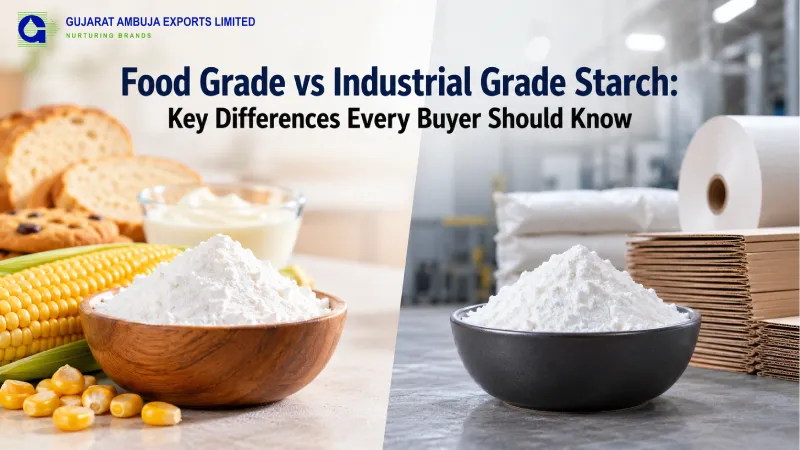
The main difference lies in the intended application, quality specifications, and safety requirements.
Food grade starch is manufactured and evaluated for use in food products. It must meet applicable food safety requirements and suitable specifications for contaminants, microbiological quality, and purity.
Industrial grade starch is intended for non-food applications such as paper manufacturing, textile processing, adhesives, and packaging.
Industrial grade starch should never be used as a substitute for food grade starch without verified food-use suitability.
Understanding this distinction helps buyers select appropriate materials for their manufacturing operations.
Food Grade vs Industrial Grade Starch: Key Differences
Buyers can compare both categories using these important criteria.
| Comparison Factor | Food Grade Starch | Industrial Grade Starch |
|---|---|---|
| Intended Use | Food and beverage manufacturing | Paper, textiles, adhesives, and other industrial processes |
| Quality Requirements | Food safety and ingredient specifications | Application-specific technical specifications |
| Testing Focus | Purity, contaminants, microbiological quality | Viscosity, bonding, consistency, and other functional properties |
| Main Function | Thickening, binding, texture improvement | Binding, sizing, coating, and processing performance |
| Documentation | Food-grade specifications and relevant compliance documents | Technical specifications and industrial quality documents |
As a Starch and Derivatives Manufacturer in India, we recognize that different industries require starch with different performance characteristics.
Why Food Grade Starch Quality Matters
Food grade starch is widely used in processed foods because of its thickening, binding, and texture-enhancing properties.
Manufacturers commonly use suitable starch ingredients in soups, sauces, bakery products, desserts, and confectionery.
However, functional performance alone is not enough.
Food-grade starch should be safe for human consumption and comply with the specific quality standards required for its intended use in food products.
Buyers should pay particular attention to microbiological specifications, moisture content, impurities, and the documentation supporting food-grade suitability.
These considerations help food businesses maintain consistent manufacturing standards and reduce avoidable raw material risks.
How Industrial Grade Starch Supports Manufacturing
Industrial starch is selected primarily for its functional performance in non-food manufacturing processes.
Its properties can support different production requirements:
- Paper Manufacturing: Starch helps improve paper strength, surface characteristics, and printability.
- Textile Processing: It is used in sizing formulations to improve yarn handling during weaving.
- Adhesive Manufacturing: Starch-based formulations provide bonding properties for applications such as corrugated packaging.
- Surface Coating: Suitable starch formulations help achieve desired coating and finishing characteristics.
Performance requirements vary depending on the industrial process and the starch formulation.
Buyers comparing Starch Manufacturers in India should evaluate whether the available grade matches their specific production conditions.
Key Quality Parameters Buyers Should Compare
Selecting the correct starch requires more than checking whether a product is labelled food grade or industrial grade.
Buyers should carefully evaluate the following key factors before proceeding with a bulk purchase:
- Moisture Content: Important for storage stability and processing consistency.
- Viscosity: Influences thickening, coating, and processing performance.
- Purity: Helps determine suitability for the intended application.
- pH: Relevant to formulation behaviour and process compatibility.
- Microbiological Quality: Particularly important for food-grade applications.
- Technical Documentation: Provides specifications needed for product evaluation.
The right starch grade depends on both its intended use and measurable quality characteristics.
At Gujarat Ambuja Exports Limited, we understand the importance of matching starch properties with customer manufacturing requirements.
How to Choose the Right Starch for Your Application
A practical purchasing decision begins with understanding how the starch will be used.
- Identify Your Application: Determine whether the starch is intended for food manufacturing or an industrial process.
- Review Product Specifications: Compare moisture, viscosity, purity, and other relevant characteristics.
- Check Grade Suitability: Confirm whether the supplied product meets your intended-use requirements.
- Request Technical Documentation: Review available specifications and relevant test information.
- Evaluate Supply Consistency: Consider batch-to-batch quality and ongoing procurement requirements.
Working with experienced Starch Manufacturers in India can help buyers discuss product specifications and processing needs.
Similarly, selecting a knowledgeable Starch and Derivatives Manufacturer in India can simplify the evaluation of starch-based ingredient options.
Why Choose Us
At Gujarat Ambuja Exports Limited, we bring our maize-processing experience to the manufacturing of starch and starch derivatives for diverse applications. Our product portfolio includes maize starch, pregelatinized starch, liquid glucose, maltodextrin, dextrose, and other starch-based ingredients. We understand that food processors and industrial buyers have different technical requirements. Our team focuses on product quality, manufacturing consistency, and customer needs, helping businesses discuss suitable ingredient options based on their applications and specifications.
Conclusion
Food grade and industrial grade starch serve different manufacturing purposes, even when their appearance is similar. Food grade starch requires appropriate food safety and quality controls, while industrial grade starch is evaluated for its intended technical performance.
Understanding these differences helps buyers make informed sourcing decisions and avoid unsuitable substitutions.
At Gujarat Ambuja Exports Limited, we recognize that selecting the correct starch is essential for manufacturing performance. Whether you are evaluating Starch Manufacturers in India or searching for a reliable Starch and Derivatives Manufacturer in India, reviewing product specifications, quality requirements, and application suitability should remain your priority.
Call to Action
Looking for maize starch or starch derivatives for your manufacturing business?
Connect with our team to discuss product grades, technical specifications, and bulk supply requirements.
Call Us: +91 79-61556677
Email: info@ambujagroup.com
Contact us today to find suitable starch and derivative solutions for your production needs.