

Key Takeaways
- Liquid glucose offers texture and crystallization control, making it ideal for confectionery applications.
- Dextrose is a simple sugar that provides predictable sweetness and is often used in dry blends.
- Choosing between liquid glucose and dextrose requires understanding their unique properties for food applications.
- Liquid Glucose (Sweetose) Manufacturers In India play a key role in delivering quality ingredients for industrial food products.
- Liquid glucose adds viscosity, moisture retention, and crystallization control to confectionery products.
Gujarat Ambuja Exports Limited is a leading manufacturer of liquid glucose and starch derivatives for food and industrial applications. When choosing between liquid glucose and dextrose, food manufacturers must consider more than sweetness. Texture, moisture retention, crystallization, and processing requirements also influence ingredient selection.
As one of the established Liquid Glucose (Sweetose) Manufacturers In India, we understand how the right sweetener can improve product consistency and manufacturing performance.
What Is the Difference Between Liquid Glucose and Dextrose?
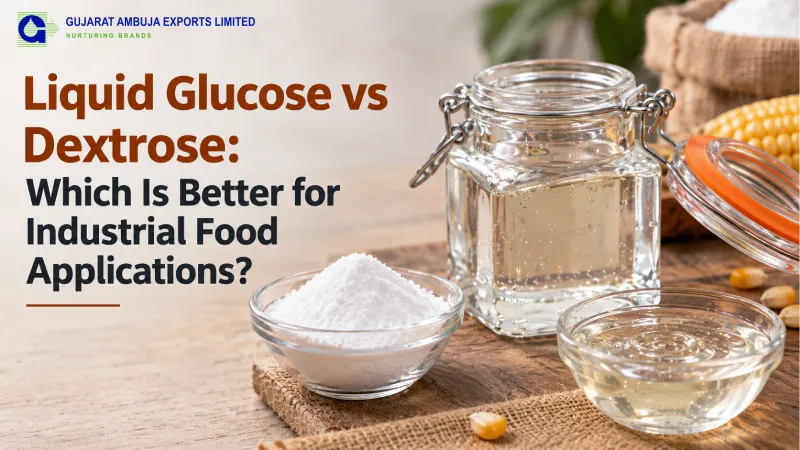
Liquid glucose is a viscous syrup produced through the partial hydrolysis of starch. It contains glucose, maltose, and other carbohydrates that contribute to its functional properties.
Dextrose, on the other hand, is a simple sugar chemically identical to glucose. It is commonly supplied as a crystalline powder for industrial food processing.
The key difference is functionality: liquid glucose contributes sweetness, body, and crystallization control, while dextrose provides direct sweetness and fermentable sugar.
Both ingredients have valuable applications, but they are not always interchangeable.
Liquid Glucose vs Dextrose: Key Differences
Understanding their characteristics helps manufacturers select an ingredient suitable for specific formulations.
| Feature | Liquid Glucose | Dextrose |
|---|---|---|
| Physical Form | Thick, viscous syrup | Crystalline powder |
| Composition | Mixture of glucose and other saccharides | Glucose |
| Sweetness | Varies with DE and composition | Consistent sweetness profile |
| Texture | Adds body and controls crystallization | Contributes sweetness and dissolved solids |
| Moisture | Supports moisture retention | Influences water activity and moisture balance |
| Common Applications | Candies, toffees, bakery, frozen desserts | Beverages, bakery, confectionery, fermentation |
The choice depends on the desired sweetness, processing conditions, and finished product characteristics.
Why Liquid Glucose Is Preferred in Confectionery Manufacturing
In confectionery production, texture and crystallization control are essential. Liquid glucose helps manufacturers achieve the required consistency in candies, caramels, toffees, and similar products.
It interferes with sucrose crystallization, helping create smoother textures while providing body and viscosity.
Liquid glucose is particularly useful when controlling sugar crystallization is more important than simply increasing sweetness.
Food manufacturers working with Liquid Glucose (Sweetose) Manufacturers In India should consider syrup composition and Dextrose Equivalent (DE) when selecting the appropriate grade.
When Is Dextrose Better for Industrial Food Processing?
Dextrose is often preferred when manufacturers need a readily soluble, fermentable sugar with predictable composition.
Its applications include:
- Bakery Products: Provides fermentable sugar for yeast-based formulations and contributes to browning.
- Beverages: Offers sweetness and dissolves readily in properly designed liquid formulations.
- Fermented Foods: Acts as a carbohydrate source for suitable fermentation processes.
- Confectionery: Supports sweetness and solids balance in selected formulations.
- Dry Food Mixes: Its powdered form makes it convenient for dry blending applications.
Unlike liquid glucose, dextrose does not provide the same combination of syrup viscosity and crystallization-control properties.
Therefore, manufacturers should evaluate the ingredient's role before substituting one for the other.
How Does Dextrose Equivalent Affect Liquid Glucose Performance?
Dextrose Equivalent, commonly called DE, indicates the degree of starch hydrolysis in glucose syrups.
It influences sweetness, viscosity, fermentability, and other functional characteristics.
Generally, lower-DE glucose syrups offer greater viscosity and body, while higher-DE syrups contain more reducing sugars and tend to provide greater sweetness.
At Gujarat Ambuja Exports Limited, we recognize the importance of selecting liquid glucose according to the processing and formulation requirements of different industries.
Businesses sourcing from Liquid Glucose (Sweetose) Manufacturers In India should confirm the available DE specifications before choosing a syrup.
Which Sweetener Is Better for Different Food Applications?
Neither ingredient is universally better. The right choice depends on its intended function.
For example, liquid glucose can be useful in chewy confectionery where body and crystallization control are important. Dextrose may be preferred in dry bakery mixes or formulations requiring a crystalline, readily fermentable sugar.
In frozen desserts, glucose syrup can contribute to texture and freezing characteristics, while dextrose can adjust sweetness and freezing point.
The best formulation may use liquid glucose, dextrose, or a combination of both. Their proportions should be determined through formulation trials.
What Should Food Manufacturers Check Before Selecting Liquid Glucose?
Before finalizing a supplier, buyers should assess the ingredient's technical characteristics and suitability for their manufacturing process.
- Dextrose Equivalent (DE) and carbohydrate composition
- Viscosity and handling requirements
- Sweetness and desired product texture
- Solids content and moisture contribution
- Food-grade specifications and quality documentation
- Batch consistency and bulk supply requirements
Experienced Liquid Glucose (Sweetose) Manufacturers In India can help buyers review available technical specifications for their intended food applications.
Why Choose Us
At Gujarat Ambuja Exports Limited, we combine our agro-processing experience with starch derivative manufacturing capabilities to serve food and industrial manufacturers. Our liquid glucose offerings support applications requiring sweetness, viscosity, moisture retention, and crystallization control. We understand that ingredient performance depends on formulation needs, processing conditions, and consistent specifications. Our team works with industrial buyers to discuss product characteristics, application requirements, and bulk sourcing needs. We focus on building reliable customer relationships through our manufacturing expertise and product portfolio.
Conclusion
Choosing between liquid glucose and dextrose requires a clear understanding of their functional differences. Liquid glucose is particularly valuable for managing texture, viscosity, moisture, and sugar crystallization. Dextrose is useful when manufacturers require crystalline glucose, predictable sweetness, or a fermentable carbohydrate source.
For confectionery, bakery, beverages, and frozen desserts, the ideal ingredient depends on the final formulation.
At Gujarat Ambuja Exports Limited, we understand the importance of selecting suitable starch derivatives for industrial food manufacturing. Businesses evaluating Liquid Glucose (Sweetose) Manufacturers In India should prioritize product specifications, application compatibility, and supply consistency when selecting a manufacturing partner.
Call to Action
Looking for liquid glucose for your food manufacturing business?
Connect with our team to discuss liquid glucose specifications, industrial applications, and bulk supply requirements.
Call: +91 79-61556677
Email: info@ambujagroup.com
Contact us today to explore liquid glucose solutions suited to your production requirements.