

Vanaspati Ghee will be 40,653 Crore Industry by 2024 in India
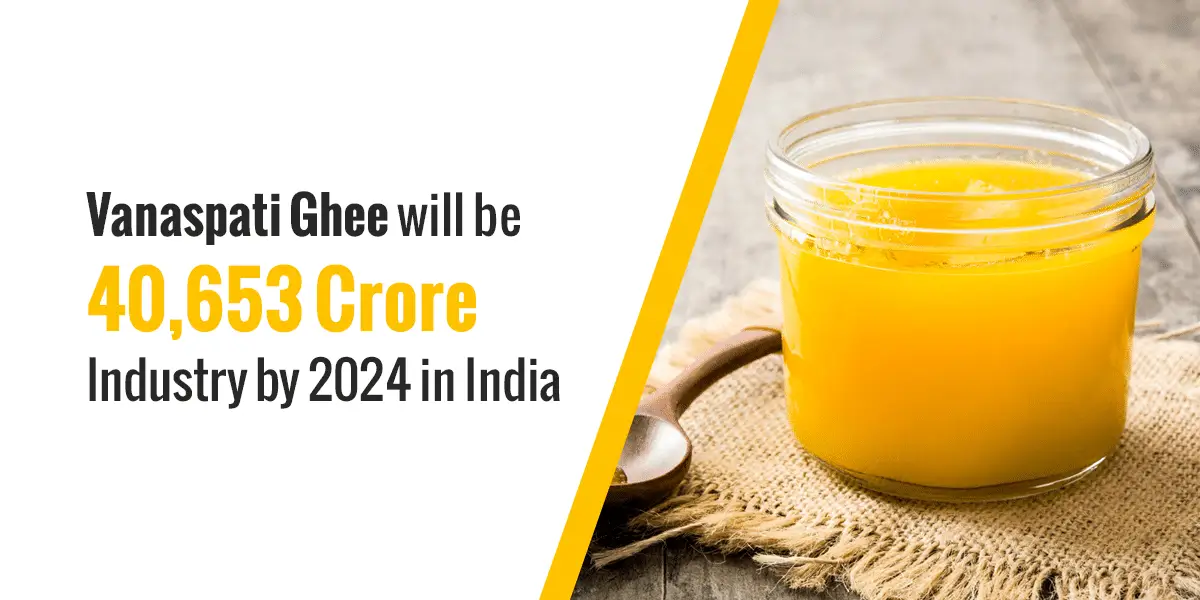
With the Vanaspati Ghee industry set to expand quickly over the next few years, it is important for investors and at-home cooks alike to familiarize themselves with this culinary staple of the Indian subcontinent. It is predicted that the Vanaspati Ghee will be 40,653 Crore Industry by 2024 in India, and there are an incredibly diverse and interesting set of factors that explain this—ranging from population growth, increases in social mobility/disposable income, ease of access, and even the potential health bene ts of these products.
What is Vanaspati Ghee?
To explain Vanaspati Ghee, it is best to start with an explanation of what Ghee is. Ghee is a class of clari ed butter, created through a process of simmering butter until it separates into liquid fats and milk solids. As this occurs, impurities are removed from the surface while solid residue settles at the bottom. Ghee is cooked longer than clari ed butter, giving it a distinct avor and yellowish hue. Once complete, the ghee is strained to remove milk particles, and allowed to cool.
Ghee has a higher boiling point than clari ed butter and also has a stronger taste and nuttier avor. This makes it an incredibly popular ingredient for cooking and frying food, as well as being a healthier alternative to traditional butter. Interestingly, Ghee has taken on a revered status in some religions, being used in ceremonial practices—it also plays a role in Ayurveda, a traditional system of medicine developed in India thousands of years ago.
Ghee has a higher boiling point than clari ed butter and also has a stronger taste and nuttier avor. This makes it an incredibly popular ingredient for cooking and frying food, as well as being a healthier alternative to traditional butter. Interestingly, Ghee has taken on a revered status in some religions, being used in ceremonial practices—it also plays a role in Ayurveda, a traditional system of medicine developed in India thousands of years ago.
Vanaspati Ghee, a fully or partially hydrogenated vegetable cooking oil made from palm or palmolein oil , is an incredibly important and popular product in India. Hydrogenation is performed using nickel as a catalyst and employing low-medium pressure reactors. Much like Ghee, it has a rich taste and avor that works well when using it for cooking purposes. It also contains a large amount of trans-fat and is a major dietary source for those living on the subcontinent. As it stands, Vanaspati Ghee has a roughly 10% share of the edible oil market, and 1.2 million tonnes of it are produced annually.
Why is the Industry Growing?
India has a relatively high consumption of edible oils, and a signi cantly high rate of Vanaspati use over other nations. Vanaspati and other oils are a staple of the Indian kitchen, seeing regular use in daily meals. Given this existing market saturation and popularity, it makes sense that the market would be highly pro table in a country of 1.25 billion.
With a population set to reach 1.53 billion by 2030, the Vanaspati Ghee is bound to rise as well, creating a stable market base with a future of organic growth. Evolving in conjunction with India's population growth is the availability of social mobility. More and more Indian citizens are nding it easier to transition between social classes. The impact of a rising middle class will be dif cult to predict for the Vanaspati Ghee market.
Traditionally, the lower class prefers to use Vanaspati for its versatility and relative affordability, while the middle class favors re ned oils. This trend is not set in stone, however, and there is room for the rising middle class to bring their Vanaspati preference with them while exiting their previous class. Additionally, Vanaspati is not restricted to at-home use and is a popular cooking ingredient in many eating establishments across India. As the access to disposable income increases for those entering the middle class, their increased rate of 'dining out' or 'ordering in' will have a noticeable increase in the indirect consumption of Vanaspati.
Not only is Vanaspati experiencing a market boon, but so too is Ghee. The increased rate of disposable income is not just pushing people to dine out, but also to spend more on dining in. Similarly, the rise in popularity of “traditional Indian” restaurants has seen an increase in Ghee used for those dishes that require it. As people are willing to spend more on a 'traditionally' cooked dish, the sale of Ghee to restaurants and other establishments is bound to increase.
Additionally, Ghee is viewed by many to have positive health bene ts. Being rich in fat-soluble vitamins A, D, & E—Ghee is believed to help build strong bones, aid digestion, and even decrease in ammation for those who suffer from it. The perception of Ghee as a healthier alternative to butter and other unhealthy cooking alternatives is a factor in its market growth, as is its existing penetration into the market.
Still, the growth of Ghee in the market has been hindered by the continued popularity of cheaper alternatives, as well as examples of 'Ghee' substitutes that have been cut with re ned and hydrogenated vegetable oils to reduce the price at the cost of purity. It is also important to note the overconsumption of Ghee may lead to cardiovascular disease, something which may have a negative impact on the market.
Looking Forward
With all of these factors at play, the Vanaspati Ghee market is set to experience several years of growth and further market saturation over the next few years. Elements such as population growth, increased social mobility, growing disposable income, and the rising popularity of restaurant dining—make it so the immediate future of the Vanaspati Ghee market remains on stable factors that are unlikely to reverse in any meaningful way over the next decade .
A staple of kitchens on the Indian subcontinent, Vanaspati Ghee is unlikely to have its signi cant culinary and cultural impact seriously challenged by local competitors for some time to eat.